Our Monthly IPv4 Analysis Just Got a Face List
Before we jump in, a graceful tip of the hat to the thousands of readers who’ve been following our monthly report over the last 7 years. Seriously, your consistent feedback, appreciation and engagement has been incredible. Good, bad or indifferent, we thank you all the same.
This year, we’re shaking things up a bit. Rather than tracking IPv4 demand signals, we’re zooming out to focus more on global IPv4 transfer activity, the companies that are driving the markets, and the real economic ripple effects shaping the IPv4 industry.
Same data obsession, just a broader lens. And if that wider spotlight happens to ruffle a few feathers in that big, beautiful cloud… well, we promise it’s all in the spirit of healthy industry transparency.
AWS Buys 9 Million IP Addresses – Monopoly or Smart Business?
According to public records, AWS picked up another 9 million IPv4 addresses from T-Mobile, bringing their 2026 total to 10.5 million and pushing total holdings to over 191 million since 2011. No press push — just another example of Amazon’s familiar strategy: secure scarce infrastructure early, preserve flexibility later.
The aggressive acquisition has sustained AWS cloud growth. Revenue has grown by a massive 20% year over year from $62 Billion in 2021 to $128.7 Billion in 2025. That expansion reflects new regions, enterprise onboarding, AI workloads, and global cloud adoption — all still heavily dependent on IPv4 compatibility. Once deployed inside cloud infrastructure, those addresses rarely return to circulation; they become embedded in customer environments, security policies, and network architecture, effectively tightening supply over time
 When you step back and look at the historical acquisition data, Amazon’sbehavior stands out. Since 2011, they’ve accumulated tens of millions of IPv4 addresses — often in large bursts when liquidity appears. Microsoft, Google, and Oracle have certainly been active, but Amazon’s consistency is what defines the market narrative.
This latest ~9M acquisition simply reinforces that trend. At this point, it’s less about opportunistic buying and more about long-term infrastructure positioning. IPv4 addresses have effectively become digital real estate, and Amazon clearly intends to own prime inventory wherever possible.
The Devil is in the Detail
Enterprise networks still rely heavily on IPv4 compatibility. Hosting providers still require it for customer onboarding. Hybrid cloud deployments almost always require dual-stack flexibility. Meanwhile AI infrastructure, edge deployments, and global connectivity expansion are quietly increasing IPv4 consumption rather than reducing it. Layer on top of that the explosive growth in cloud computing. AWS alone generates tens of billions annually in cloud revenue and continues posting steady year-over-year growth. That revenue growth translates directly into infrastructure expansion — more regions, more compute, more customers, more endpoints — and all of that still leans heavily on IPv4.
And here’s the part people underestimate: once IPv4 space is deployed inside cloud infrastructure, it rarely comes back to the market. These aren’t temporary allocations. They become embedded into customer environments, SaaS platforms, enterprise integrations, security policies,and network architecture. Churn is extremely low. The net effect is a slow but persistent tightening of available supply. In that environment, controlling IPv4 isn’t technical housekeeping anymore — it’s strategic leverage.
It’s one of the rare assets that behaves simultaneously like infrastructure, a commodity, and a reserve currency for network operators. So while critics occasionally frame these purchases as monopolistic, from a purely strategic perspective they’re rational — even predictable.

The AI Demand Curve Nobody Mentions Enough
Another quiet driver here is AI infrastructure. Large-scale compute clusters, hybrid environments, and globally distributed edge deployments still lean heavily on IPv4 for compatibility and operational simplicity. While IPv6 might eventually shoulder more of that load, the transition isn’t happening any time soon.
AWS appears to be positioning not just for today’s cloud growth, but for a decades worth of compute expansion. Buying IPv4 now is essentially future-proofing network capacity before the next demand spike becomes obvious to everyone else. That’s a classic Amazon move — see the bottleneck early, accumulate ahead of it.”
You Have to Respect the Consistent Market Leadership
So yes, you can call it market consolidation. You can call it aggressive infrastructure control. Some might even throw around the word “monopoly.” But from a strategic execution standpoint, it’s a maneuver that has proven to be successful time and time again.
Amazon tends to identify constraints early, deploy capital decisively, and let scale do the rest. They’ve done it in multiple industries, and IPv4 appears to be no exception. Credit where it’s due — they rarely hesitate when they see leverage.
Lets Revisit the Monthly IPv4 Trend Report
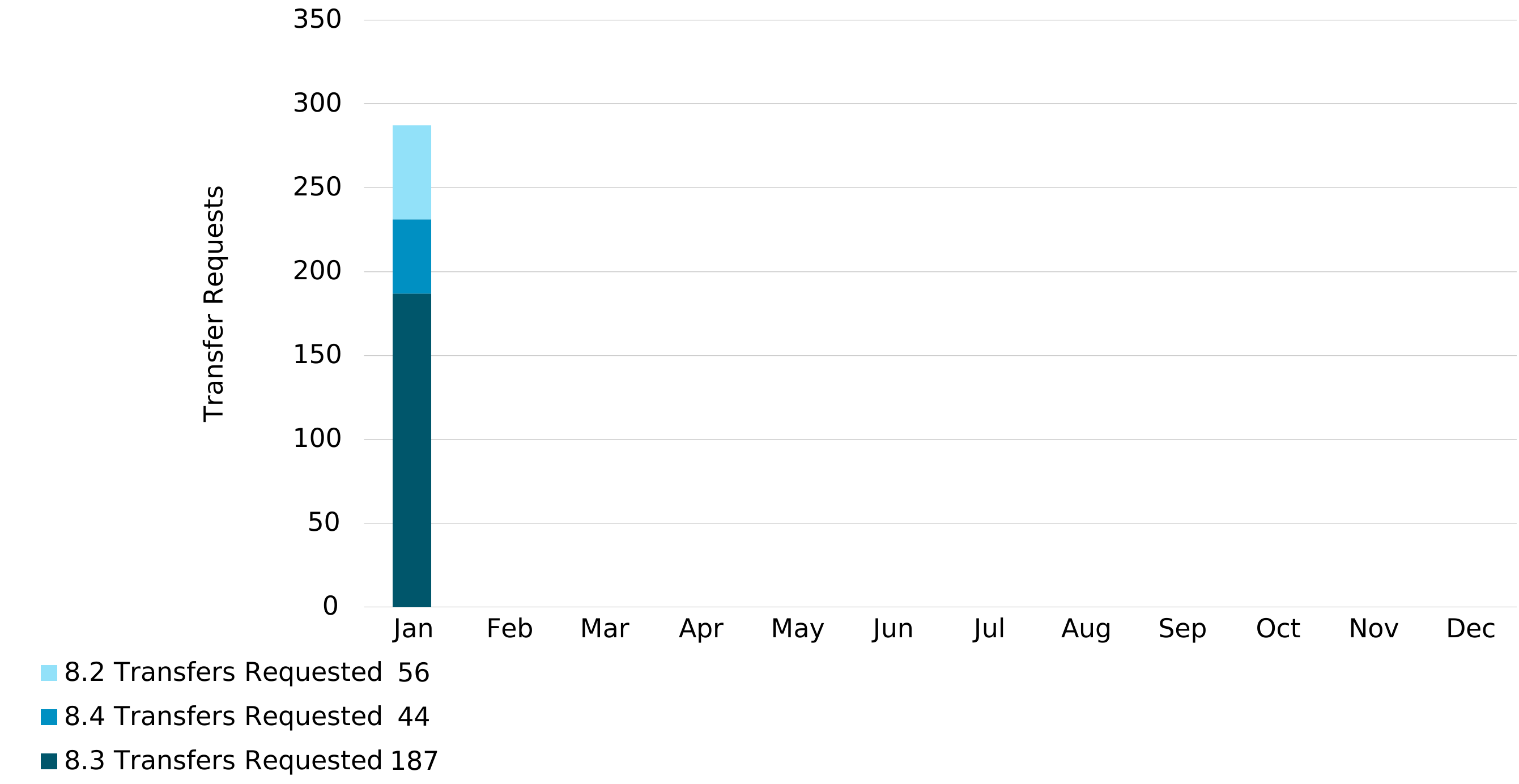
ARIN transfer requests, which we use to indicate demand, has shot out of a cannon to start year. Historically, we’ve viewed roughly 150 transfers per month as a baseline marker for healthy market demand. Recent data is showing activity closer to 187 monthly transfers, which puts demand about 24.7% above that traditional benchmark. That’s not a minor fluctuation — it’s a meaningful signal that buyer appetite remains strong despite pricing cycles, macro shifts, and ongoing IPv6 adoption chatter.
Other Popular Blog Posts
 https://i0.wp.com/brandergroup.net/wp-content/uploads/2026/04/the-importance-of-ipv4-prefix-diversity-the-main-concept-is-that-it-helps-prevent-an-entir-featured-scaled.jpg?fit=2560%2C1429&ssl=1
1429
2560
BG-Editorial
https://brandergroup.net/wp-content/uploads/2021/05/brander-group-buy-IPv4-logo-.svg
BG-Editorial2026-04-15 07:42:002026-04-14 19:44:05The Importance of Prefix Diversity in IPv4 Addressing
https://i0.wp.com/brandergroup.net/wp-content/uploads/2026/04/the-importance-of-ipv4-prefix-diversity-the-main-concept-is-that-it-helps-prevent-an-entir-featured-scaled.jpg?fit=2560%2C1429&ssl=1
1429
2560
BG-Editorial
https://brandergroup.net/wp-content/uploads/2021/05/brander-group-buy-IPv4-logo-.svg
BG-Editorial2026-04-15 07:42:002026-04-14 19:44:05The Importance of Prefix Diversity in IPv4 Addressing https://i0.wp.com/brandergroup.net/wp-content/uploads/2026/04/arin-waitng-list-is-ove-1-year-long-featured-scaled.jpg?fit=2560%2C1429&ssl=1
1429
2560
BG-Editorial
https://brandergroup.net/wp-content/uploads/2021/05/brander-group-buy-IPv4-logo-.svg
BG-Editorial2026-04-13 14:36:112026-04-13 14:36:14ARIN Waiting List For IPv4 Still Over a Year in 2026
https://i0.wp.com/brandergroup.net/wp-content/uploads/2026/04/arin-waitng-list-is-ove-1-year-long-featured-scaled.jpg?fit=2560%2C1429&ssl=1
1429
2560
BG-Editorial
https://brandergroup.net/wp-content/uploads/2021/05/brander-group-buy-IPv4-logo-.svg
BG-Editorial2026-04-13 14:36:112026-04-13 14:36:14ARIN Waiting List For IPv4 Still Over a Year in 2026 https://i0.wp.com/brandergroup.net/wp-content/uploads/2026/04/submarine-cables-carry-99-of-intercontinental-traffic-and-they-re-under-threat-featured-scaled.jpg?fit=2560%2C1429&ssl=1
1429
2560
BG-Editorial
https://brandergroup.net/wp-content/uploads/2021/05/brander-group-buy-IPv4-logo-.svg
BG-Editorial2026-04-10 13:17:182026-04-12 21:09:11Google & Meta Take Control of Undersea Backbone
https://i0.wp.com/brandergroup.net/wp-content/uploads/2026/04/submarine-cables-carry-99-of-intercontinental-traffic-and-they-re-under-threat-featured-scaled.jpg?fit=2560%2C1429&ssl=1
1429
2560
BG-Editorial
https://brandergroup.net/wp-content/uploads/2021/05/brander-group-buy-IPv4-logo-.svg
BG-Editorial2026-04-10 13:17:182026-04-12 21:09:11Google & Meta Take Control of Undersea Backbone
