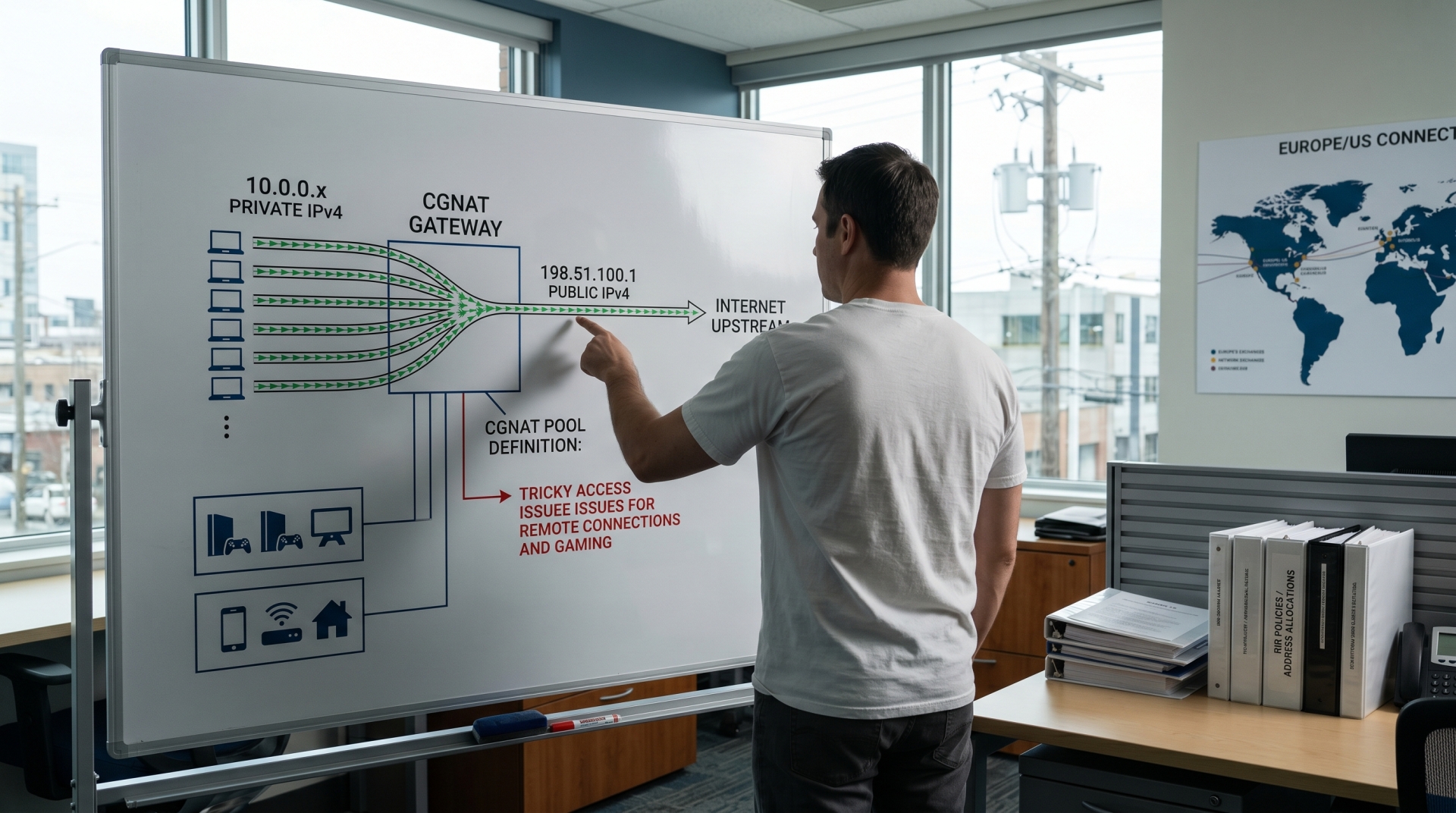
Public IPv4 stopped being plentiful years ago. That is why internet providers now use Carrier-Grade NAT, or CGNAT, to let many customers share 1 public IPv4 address instead of assigning 1 to every line. Most people do not notice until a game console, security camera, or remote desktop setup suddenly acts like the internet has opinions.
How Carrier-Grade NAT Actually Works
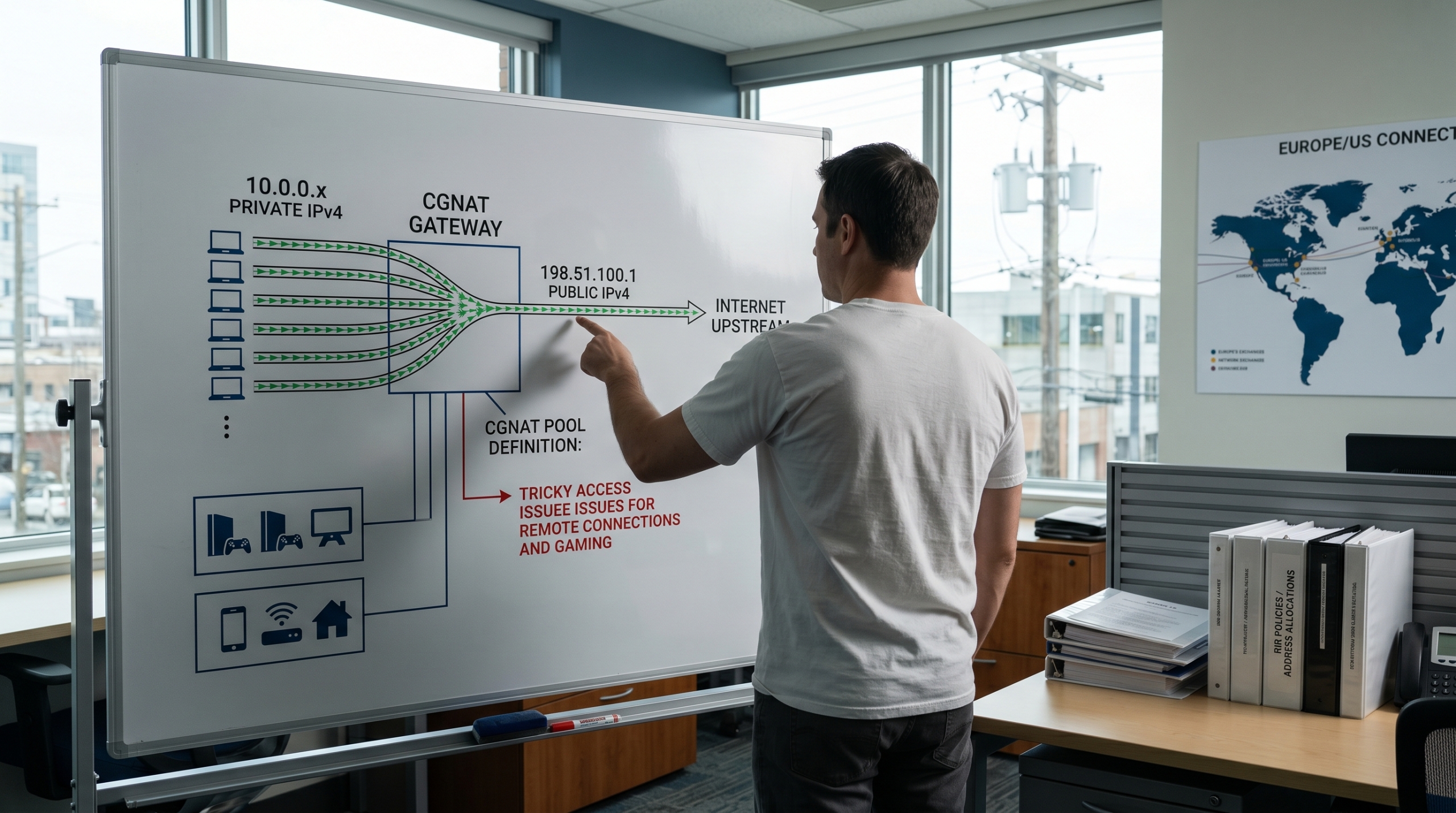
CGNAT is regular NAT moved from your home router into the ISP network. Your router still gives your devices private addresses at home, but your provider also places your connection behind another translation layer upstream. When you open a website or app, the ISP maps your session to a shared public IPv4 address and a unique port number, then keeps that entry in a translation table so the return traffic gets back to you instead of your neighbor.
The simplest way to picture it is a hotel switchboard. Hundreds of rooms can share the same main phone number because the operator tracks which extension started each call. At network scale, that tracking matters, which is why disciplined IPAM and logging are part of the job, not optional garnish.
Why ISPs Use CGNAT to Stretch IPv4
The business case is blunt: ARIN exhausted its free IPv4 pool on September 24, 2015, while demand for always-on broadband kept climbing. CGNAT gives operators breathing room by reducing how many public addresses they need to buy, lease, or hold in reserve. That matters even more during growth, acquisitions, and network consolidation, where an ISP may need to support a lot more customers before it is ready to buy IPv4 on the market.
It also fits the awkward middle stage the industry is still living in. Google crossed 50.10% IPv6 usage in April 2026, but APNIC still put weighted global IPv6 capability at about 42%. Translation: IPv6 is real, but IPv4 compatibility is still hanging around the office and touching everything.
Where CGNAT Helps and Where It Hurts
CGNAT helps operators conserve scarce addresses, simplify rollout speed, and delay unnecessary IPv4 spending. For users who mostly browse, stream, and scroll, it often works fine in the background. For services that depend on inbound connections, it gets messier. Port forwarding, self-hosted apps, some multiplayer games, VPN setups, and remote-access tools can break or need workarounds because the public address is shared instead of dedicated.
There is also an operations cost. Abuse complaints, law-enforcement requests, and troubleshooting become harder because one public IPv4 can represent many subscribers at once. That is why the real argument is not whether CGNAT exists. It is whether the operator has the logging, support process, and design discipline to run it cleanly, which is the practical tradeoff behind Brander Group’s earlier look at deploying CGNAT.
What Real-World CGNAT Deployments Show
A good recent example came from FullFibre in the UK. After combining 3 ISP footprints, it used integrated BNG and CGNAT software on standard x86 servers to scale capacity for more than 140,000 subscribers. The company said that setup could cut its IPv4-related costs by 40% over 3 years by returning excess blocks, while also reducing rack space and power draw by half. That is not a philosophy seminar. That is an operator deciding scarce IPv4 should stop eating money and floor space.
The same case study also said DHCP lease times dropped from 1 hour to 5 minutes, which improved how quickly lost sessions could be detected and renegotiated. That detail matters because it shows where CGNAT lives in the real world: not as a magical fix, but as one part of a broadband edge design that has to balance address scarcity, performance, support burden, and the slow march toward IPv6.
FAQ
What does CGNAT stand for?
CGNAT stands for Carrier-Grade Network Address Translation. It is NAT performed inside an ISP network so many subscribers can share a smaller pool of public IPv4 addresses.
Why do ISPs use CGNAT instead of giving everyone a public IP?
They use it because public IPv4 space is scarce and expensive. CGNAT lets operators serve more customers without assigning a unique public IPv4 address to every connection.
Does CGNAT affect gaming or port forwarding?
Yes. CGNAT can interfere with port forwarding, peer-to-peer gaming, inbound VPN access, self-hosted services, and any application that expects a direct public IPv4 endpoint.
Is CGNAT the same as IPv6?
No. CGNAT is an IPv4 conservation method. IPv6 is the long-term addressing standard intended to reduce the need for address sharing in the first place.
How can you tell if your ISP uses CGNAT?
If the WAN address on your router is private or does not match the public IP seen by outside websites, you may be behind CGNAT. Your ISP can usually confirm it.