While the tech press spent the last decade breathlessly covering every NFT rug pull, every SPAC implosion, and every vaporware AI startup that raised $200 million on a pitch deck, one of the most structurally interesting asset markets in the history of the internet was operating in complete silence — no public price index, no volume reporting, no geographic data, no mainstream coverage. A $15 billion secondary market running on industry knowledge., registry filings, and the kind of technical acumen that doesn’t show up in a Google search. The people who knew about it I acquired all the assets. Everyone else is going to be stuck fighting for scraps.
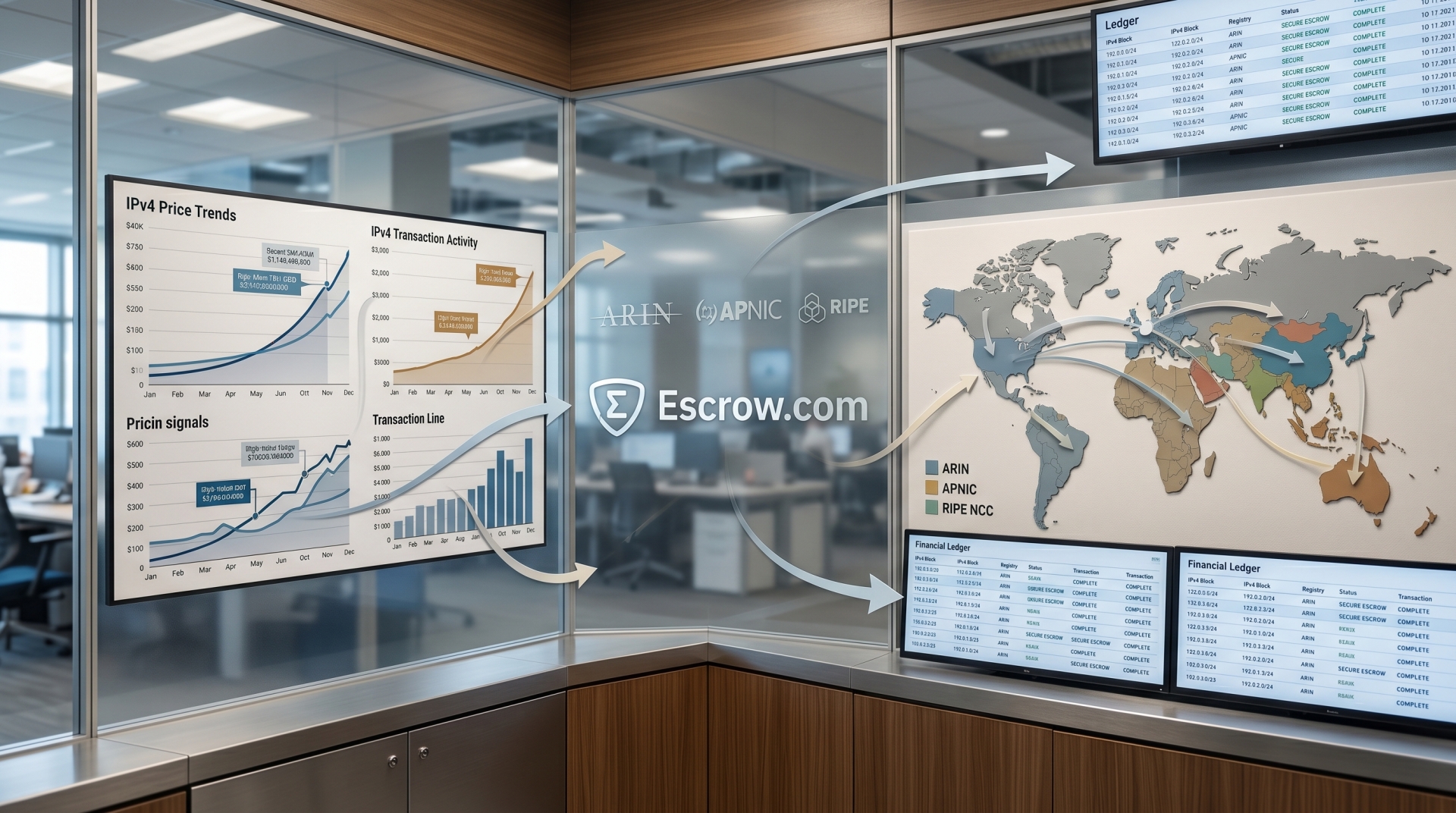
Here’s the short version: every device on the internet needs an IPv4 address to communicate. There are only 4.3 billion available and they ran out in 2011. Not “running low” — exhausted. The official waiting list for new allocations through ARIN now runs 12 to 20 months, and when you finally reach the front of the line, the maximum they’ll hand you is 1,024 addresses. Good luck deploying a network operation on that. The world has been quietly trading existing addresses ever since, and until Escrow.com published the first mainstream public market index this month, almost none of it was visible to anyone outside the industry.
AWS Built a Toll Booth on the Internet and Nobody Noticed
The most uncomfortable number in this whole story isn’t the market size. It’s AWS and other hyperscale’s. Amazon has accumulated an estimated 191 million IPv4 addresses since 2011, a stockpile worth approximately $7 to 8 billion. They have also generated a revenue stream of up to $1 billion per year just for access to that inventory. Read that again slowly: Amazon bought infrastructure that the internet requires, sat on it while everyone kept moving to the cloud — and now rents it back to the companies building the future.
To be fair to Amazon, it’s a genuinely brilliant play. AWS revenue grew from $62 billion in 2021 to $128.7 billion in 2025, and every dollar of that growth came with more regions, more enterprise onboarding, more AI workloads, all of it still dependent on IPv4 compatibility. Once those addresses get embedded inside customer environments, security policies, and network architecture, they don’t come back to market. Churn is essentially non-existent. The net effect is a slow, systematic tightening of available supply orchestrated by a handful of the largest buyers in that market. You can call it monopolistic. You can call it visionary. Either way, it worked.
The hyperscaler IPv4 buying spree is what drove prices to that $55 per IP peak — and when AWS changed its billing model in 2023, passing IPv4 costs directly to customers, their acquisition pressure dropped overnight, and the market corrected hard toward $10 per IP over the past 2 to 3 years until the end of 2025. The analysts who called it demand destruction missed the obvious point: you don’t have demand destruction when the same scarcity that created the market still exists. You have several dominant buyers temporarily stepping back. That’s not the same thing, and the market is now proving it.

The Indiana Joneses That Helped Start It All
Here’s the part of this story that doesn’t fit neatly into a quarterly earnings call. With no new IPv4 space being created — the only supply in this market comes from hunting down addresses that are already allocated but sitting dormant. That means tracing corporate lineage through decades of mergers, acquisitions, bankruptcies, and name changes. It means finding blocks that were handed out in the 1980s to universities and brick and mortar stores that had absolutely no need for large amounts of IP addresses, and the early adopters of the internet who simply forgot they even had them. Escrow.com CEO Matt Barrie described the brokers doing this work as the Indiana Joneses of the internet — trekking through far-flung registry records, to fined, recover and bring these scarce assets to the market.
Jake Brander has been doing this since 2016, when he looked at a global IPv4 shortage and concluded, correctly, that there was no reliable system for making these available to ISPs, hosting companies and data centers at scale. So, he built a proprietary system to do just that. What became Brander Group now runs 50 to 80 transactions each month across ARIN, RIPE, and APNIC & LACNIC, has served over 3000 clients in more than 60 countries, and is approaching $1 billion in total IPv4 transaction volume — placing it among the highest-volume independent IPv4 brokers globally. The single largest deal: $89 million to a multinational cloud provider in a single transaction and having the best year of over 230 million in sales
What made those early deals possible wasn’t just the sourcing. It was trust infrastructure that didn’t exist yet. Brander Group’s partnership with Escrow.com — the world’s largest online escrow provider — gave buyers and sellers in dozens of countries a secure mechanism for moving hundreds of millions of dollars of IP blocks across international borders at a time when nobody had a playbook. That partnership didn’t just close transactions. It created the conditions under which a real market could function, and that distinction matters when you’re talking about building a new vertical in a space where the assets are invisible, the transfers are technical, and the counterparties are scattered across six continents.
The Next Big IPv4 Wave Is Already Here
The people calling the current price environment a permanent correction are making the same mistake the “demand destruction” crowd made in 2023. They’re watching one variable and ignoring everything else. ARIN transfer requests came in at 174 per month in recent data, running above both the current-year monthly average and the 3-year baseline of 150 requests per month. That’s not a market in retreat. That’s a market with broadening buyer participation, which is actually a healthier signal than the hyperscaler-dominated frenzy that peaked in 2021.
The demand composition has changed, not the demand itself. Major VPS and cloud providers like Oracle, Zscaler, PacketHub, Eons, Byteplus, Hostinger & Hetzner are now showing up as major buyers — not for speculation, but because they need the addresses to run actual infrastructure. Every new virtual machine, every customer onboarded to a hosting platform, every AI inference endpoint requires routable public IPv4 space. AI is the accelerant nobody fully priced in, because every autonomous agent operating on the internet needs its own IP address. You cannot run serious AI infrastructure behind CGNAT, and the agentic AI boom is not a trend that self-corrects.
Then there’s the $22 billion in BEAD broadband funding sitting in federal reserve, earmarked for infrastructure deployment in underserved markets. When that capital starts moving — and it is moving, with states already receiving approvals — it pushes a wave of new ISPs, fiber operators, and regional network buildouts directly into the transfer market. This isn’t speculative pressure. It’s contractual deployment pressure, with timelines attached to government funding agreements. Brander Group is already calling prices for /16s subnets and larger will double to $20 per IP conservatively by year-end, and the Q1 2026 data backs it up. Almost $20 million address changed hands in the first quarter alone, on pace for the busiest transfer year since 2020.
The $15 billion market that nobody covered is about to become very loud. The people who understood it early have already positioned. Everyone else is reading about it now.
Other Popular Blog Posts
 https://brandergroup.net/wp-content/uploads/2026/05/May-26-IPv4-Scarcity-Never-Left-The-Market-Just-Forgot.png
929
1693
Brander Group
https://brandergroup.net/wp-content/uploads/2021/05/brander-group-buy-IPv4-logo-.svg
Brander Group2026-05-30 09:04:542026-05-30 20:07:46May: IPv4 Scarcity Never Left—The Market Just Forgot
https://brandergroup.net/wp-content/uploads/2026/05/May-26-IPv4-Scarcity-Never-Left-The-Market-Just-Forgot.png
929
1693
Brander Group
https://brandergroup.net/wp-content/uploads/2021/05/brander-group-buy-IPv4-logo-.svg
Brander Group2026-05-30 09:04:542026-05-30 20:07:46May: IPv4 Scarcity Never Left—The Market Just Forgot https://brandergroup.net/wp-content/uploads/2026/05/NANOG-97-Brander-Group-Sponsor.jpg
1024
1536
Brander Group
https://brandergroup.net/wp-content/uploads/2021/05/brander-group-buy-IPv4-logo-.svg
Brander Group2026-05-28 18:49:232026-05-30 20:05:04Brander Group Sponsors NANOG 97 in Bellevue, WA
https://brandergroup.net/wp-content/uploads/2026/05/NANOG-97-Brander-Group-Sponsor.jpg
1024
1536
Brander Group
https://brandergroup.net/wp-content/uploads/2021/05/brander-group-buy-IPv4-logo-.svg
Brander Group2026-05-28 18:49:232026-05-30 20:05:04Brander Group Sponsors NANOG 97 in Bellevue, WA https://brandergroup.net/wp-content/uploads/2026/05/ipv4-leasing-drops-as-buyers-option-1-featured-scaled.jpg
1429
2560
BG-Editorial
https://brandergroup.net/wp-content/uploads/2021/05/brander-group-buy-IPv4-logo-.svg
BG-Editorial2026-05-24 09:07:472026-06-01 08:16:54IPv4 Leasing Drops 15% in 2026
https://brandergroup.net/wp-content/uploads/2026/05/ipv4-leasing-drops-as-buyers-option-1-featured-scaled.jpg
1429
2560
BG-Editorial
https://brandergroup.net/wp-content/uploads/2021/05/brander-group-buy-IPv4-logo-.svg
BG-Editorial2026-05-24 09:07:472026-06-01 08:16:54IPv4 Leasing Drops 15% in 2026